Written by Soleil Parks, TAG Gallery Assistant
From September 2 through November 20, 2025, Exploring Uncertainty: An Interactive Exhibition showcased artworks by six Central Texas artists whose work engage with the theme of uncertainty. The exhibition paired ACC Faculty with invited collaborators, which included an area faculty member, an ACC alumnus, and a current ACC Studio Art student. The exhibition was organized into three thematic sections that grouped the artists’ work according to different ways uncertainty within the self is experienced and interpreted. These sections referenced the topics of: uncertainty of the self and body (Feel + Reflect); uncertainty of representation (Select + Create); and uncertainty of perception (Look + Look Again). Each pairing of artists was complemented by an interactive station that reversed the traditional gallery dynamic and asked visitors to leave their own mark on the exhibition.
About the Exhibition
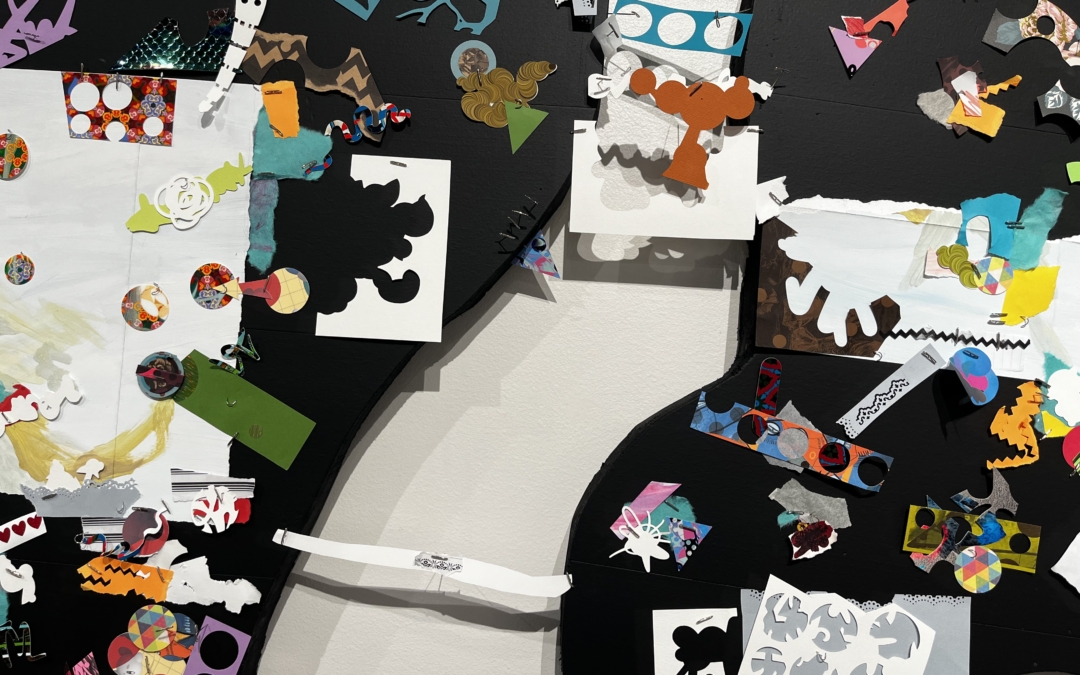
Section one of the exhibition examines uncertainty in artistic process and in self representation. Through large-scale installations which contain assembled and collaged elements, Bernie Diaz (ACC Faculty) and Ellen Crofts (ACC Alumnus) create artworks that question social classifications and cultural norms. Between their work, sharing their exhibition space, large pieces of foamcore accompanied bins of scrap material provided by the artists. In the “Select + Create” activity, visitors were encouraged to pin or tape the paper and vinyl scraps to the foam, creating a collaborative art piece with various colors, textures, and patterns. Here, visitors engaged directly with the uncertainty inherent in the artistic process. By selecting, arranging, and reworking materials, participants could experience how experimentation and artistic intuition shape creative output and lead to interpretations and portrayals of one’s own self.

The “Select + Create” activity that featured scrap material provided by artists Ellen Crofts and Bernie Diaz.

Detail of the “Select + Create” activity, where visitors used pins, tape, and scraps to create a collaborative artwork.
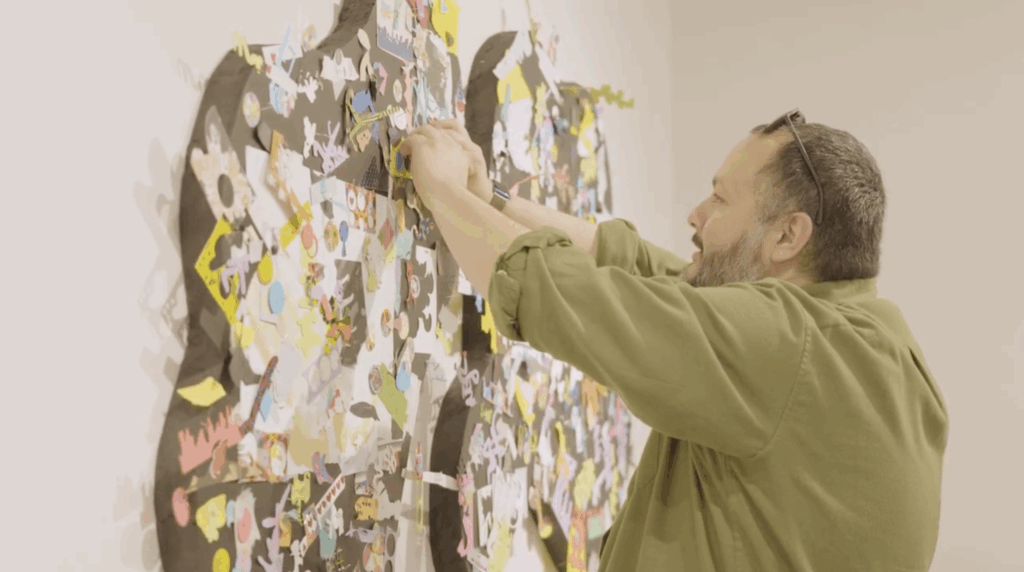
ACC Professor and Exploring Uncertainty artist Bernie Diaz tries out the “Feel + Reflect” activity, which invited visitors to work with scraps from his materials and experiment with the same kind of intuitive decision-making found in his practice.
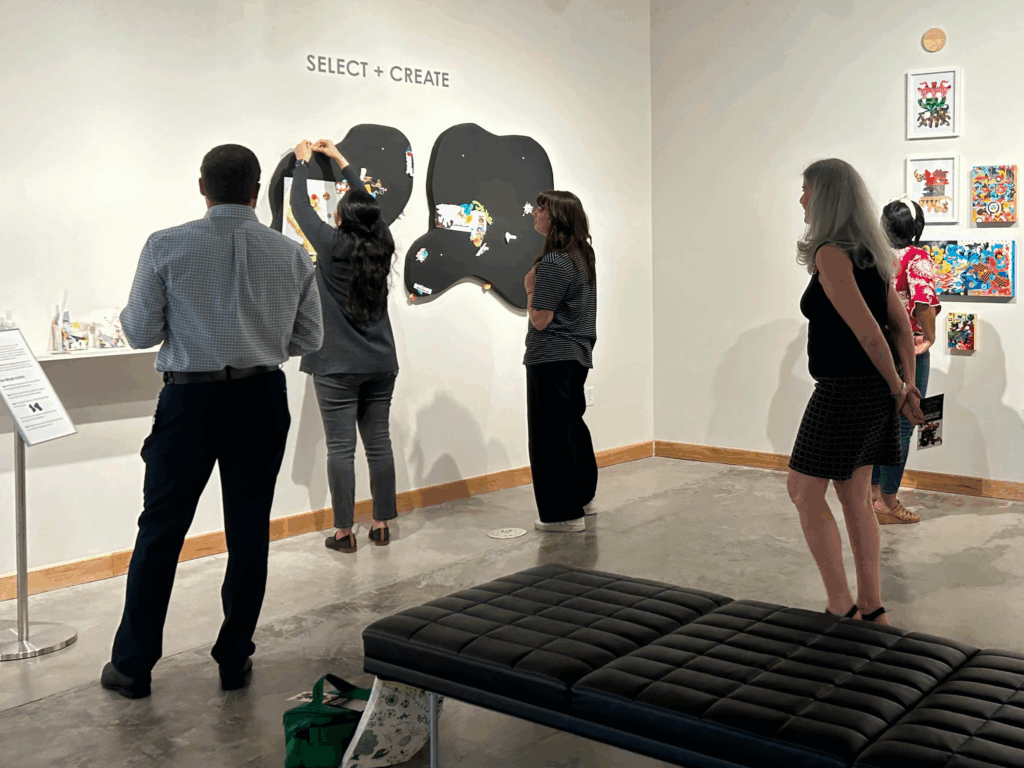
Visitors attaching materials to the foamcore supports at the beginning of the exhibition, when they were still mostly bare.
Section two of the exhibition focused on the uncertainty that comes with navigating our experience living in and coming to understand our bodies. Drawing professor Nicholas Dertien and local contemporary artist Christopher Miñán Fitzgerald explore this deeply personal topic by representing extreme internal sensations and patients in intensive care units with a humanizing, empathetic gaze. Alongside them in the center of the gallery was the “Feel + Reflect” interactive station, which consisted of a mirror, colored pencils, and black notecards. Visitors were asked to take a moment to assess their physical state, draw or write about it, and hang their card on the wall among other visitor responses. By translating inner feelings into a visual form, participants engaged in a process of self-reflection. Collectively, their responses revealed the diverse ways people experience and interpret inner uncertainty.
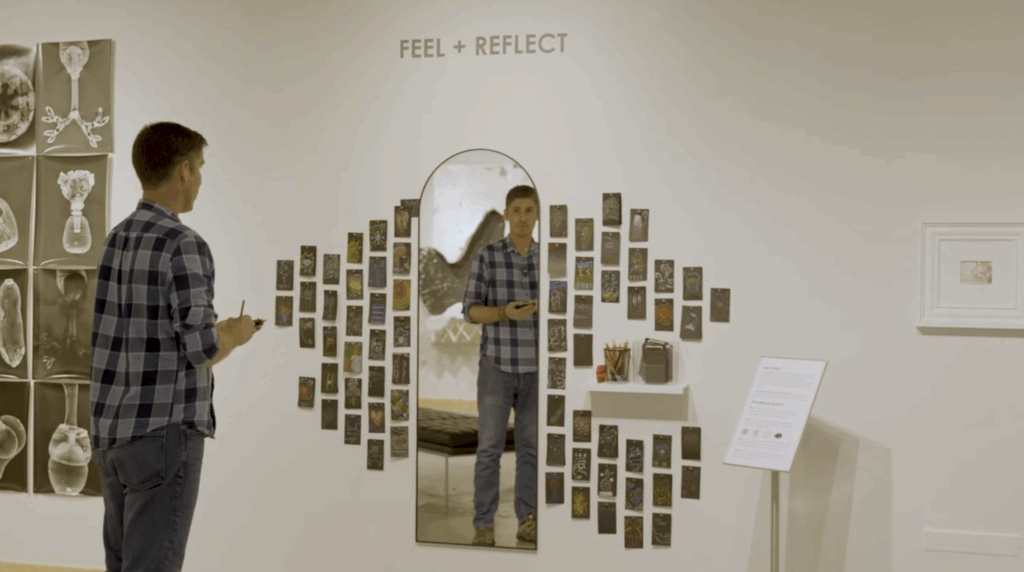
ACC Professor and Exploring Uncertainty artist Nicholas Dertien participates in the “Feel + Reflect” activity, which draws on the themes of bodily sensations/internal experiences present in his artwork.


 Examples of reflective drawings left by Exploring Uncertainty visitors.
The last section investigated the uncertainty of perception, or the way that we see and understand artworks, through color, geometry, and theory. Painting professor Shawn Camp and his student Ezra Romero show how an artwork can manifest different modes of seeing through optical effects. For example, Romero utilizes the Bezold effect and simultaneous contrast in his work, while Camp’s paintings use color and paint qualities– such as transparency and iridescence– to “imitate” the theory of Schroedinger’s cat. Alongside their work are three pairs of colored glasses (red, blue, and pink) to further challenge the viewer’s ideas about perception. In this interactive station “Look + Look again,” participants used the glasses to help see how shifts in saturation and hue alter what we see in an artwork, encouraging them to consider how subjective or uncertain visual experience can be.

The “Look + Look Again” activity, where visitors could use colored glasses to observe changes in artworks and color patterns provided by the gallery.

Gallery 2000 visitors using the glasses to look around the space.
An Educator’s Perspective on Interactivity
Exploring Uncertainty was developed as a collaboration between ACC faculty members Lana Waldrep-Appl and Matthew Iassacson and exhibition curators Norma Bickmore (TAG Curatorial Assistant) and Peter Bonfitto (TAG Gallery Director). The exhibition team worked closely on the interactive elements with Olivia Spiers, (TAG Coordinator for Outreach and Programming) who leads gallery education and curriculum integration.
To provide deeper insight into the role of interactivity in art spaces, Olivia Spiers provided her perspective on the project.
Q: How does an interactive element change the dynamic of a gallery?
A: In short terms, interactive components crack the entire art museum dynamic wide open. If we think about rules that are routinely in place at art museums, we might come up with regulations that limit us from touching artwork, running in the gallery, taking photos, or expressing loud noises. We might also think about the unwritten rules as well, such as being mindful of where we stand in an art museum, so we don’t bump into artworks or block other visitor’s viewing. All of these rules are in place to protect the artwork on display, but they also can discourage exploration and connection among visitors. Interactive elements turn this history of restrictive visitor expectations on its head by providing outlets for visitors to interpret and engage with the artworks.
Q: Why is a college gallery a good place for interactive exhibition elements?
A: Academic galleries and museums have a built in audience made up of students and active learners, which usually means visitors of these institutions approach artworks with inherent curiosity. Without realizing their impact on the space, students can often mold academic galleries to serve as forums for ideas, hopes, hard conversations, and community engagement.
With the function of academic galleries and museums in mind, our team sought to create casual and quick activities for visitors that essentially serve two learning objectives. First, we wanted hands-on activities to be another educational component that consolidates the stories and experiences that each artist is communicating through their work. Not every visitor reads labels or understands the concepts included in each description. However, by including interactive stations, we are providing one more outlet for visitors to understand and interpret the artwork for themselves.
Q: How does an interactive element play with the theme of uncertainty?
A: Every human encounters some level of uncertainty during our lives, which we can either choose to embrace or avoid. In the current exhibition, many of the artists choose to embrace the uncertainty they face in their lives through artistic expression. We can also embrace uncertainty through other methods such as creative expression, exploration, or even play. The interactive elements in Exploring Uncertainty engage a sense of exploration, which demonstrates to our student visitors that uncertainty isn’t always a negative concept. Uncertainty is critical to having moments of hope or creativity in our lives.
Art + Interactivity: Students Engage with Exploring Uncertainty
On October 21, 2025, students gathered in Gallery 2000 for the Art+ Interactivity event presented in collaboration with ACC’s Make It Center and led by Spiers and the MIC’s Sydney Jacome. During the session, students explored the exhibition’s interactive stations through a guided tour. After the tour, an ACC student shared, “I’ve sometimes had trouble understanding art, but it made it more interesting to see other students’ thoughts and responses.”
Emphasizing participation and reflection, Exploring Uncertainty challenges conventional boundaries between artwork and audience. By inviting active engagement, the exhibition demonstrates how interactive approaches can support creativity, critical thinking, and a shared sense of belonging in gallery environments.
The Art Galleries at ACC are free and open to the public Tuesday-Thursday 10am-5pm, or on Monday and Friday by appointment. Exploring Uncertainty: An Interactive Exhibition was on view from September 2 through November 20, 2025 in Gallery 2000 (HLC 2.2450) on the Highland Campus. While the current exhibition focuses on explorations of personal uncertainty, part two of Exploring Uncertainty will shift outward. On view from January 20 through March 12, 2025, the next installment brings together eight artists responding to external and societal forms of uncertainty. Like part one, the exhibition will feature interactive stations for visitors to engage with the work in their own way.
Interviews with the artists of Exploring Uncertainty can be viewed here: https://admc.austincc.edu/tag/exploring-uncertainty-part-one/
To stay up to date on future exhibitions, blog posts, and events, sign up for the TAG newsletter: https://admc.austincc.edu/tag/mailing-list-sign-up/
Recent Comments